

Agriculture
Single-cylinder diesel engines for farm machinery, pumps for the field and backup power for poultry and dairy buildings.
- Water-cooled engines from 3.8 to 22 kW for long working days
- Air-cooled engines from 3.4 to 14.9 kW for portable machines
- Silent water-cooled sets for poultry and dairy backup
The challenge
Irrigation and drainage demand equipment that runs for long, uninterrupted seasons, often in remote fields with limited service support. Fuel efficiency and simple maintenance directly affect the cost of every hectare. HTX engines and pumps are engineered for continuous agricultural duty, low fuel consumption, and easy field servicing.
Where diesel power works on a farm
On a farm the diesel engine is often the machine's power source, not a generator. It drives a power tiller, a walking tractor, a feed crusher, a thresher or a pump through a belt or a shaft. What matters there is the power at the right shaft speed, and an engine that can run all day and be repaired in the yard.
The second job is electricity for buildings. Poultry houses need ventilation fans, and dairies need milking and milk cooling. These loads cannot stop for long, so the generator works as backup.
Irrigation is the third job. It has its own page: irrigation pump sizing.
Matching the engine or set to the machine
Typical engine power for each machine. Check the power and input speed the machine's maker asks for.
| Machine or job | Typical power needed | HTX models |
|---|---|---|
| Micro-cultivator or power tiller | 4 to 6 kW | HTX-R175, HTX-R180, HTX-AE186 |
| Walking tractor | 7 to 11 kW | HTX-R190, HTX-WEZ12, HTX-ZS1100 |
| Feed crusher or hammer mill | 8 to 15 kW | HTX-ZS1100, HTX-WE16, HTX-AE1105 |
| Small four-wheel tractor or heavy mill | 15 to 22 kW | HTX-WE25, HTX-WE28, HTX-WE32 |
| Sprayer or portable pump drive | 3 to 5 kW | HTX-AE173, HTX-AE178 |
| Poultry house or dairy backup | 10 to 30 kVA | HTX-G10K-WS, HTX-G19K-WS3, HTX-G31K-WS3 |
Most of our water-cooled engines run at 2,200 to 2,600 rpm. Our air-cooled engines run at 3,000 to 3,600 rpm and weigh 29 to 78 kg. The machine's pulley or gearbox has to match the engine speed.
Recommended equipment
Matched to your operation
Recommended HTX equipment for this application:

21HP Single-Cylinder Water Cooled Diesel Engine
15.7 kW
Request Quote
5HP Single-Cylinder Air Cooled Diesel Engine
3.7 kW
Request Quote
200A Diesel Welding Generator Set
5 kVA
Request Quote
2" Diesel Water Pump
3.4 kW
Request Quote
2" High-Pressure Diesel Water Pump
3.7 kW
Request Quote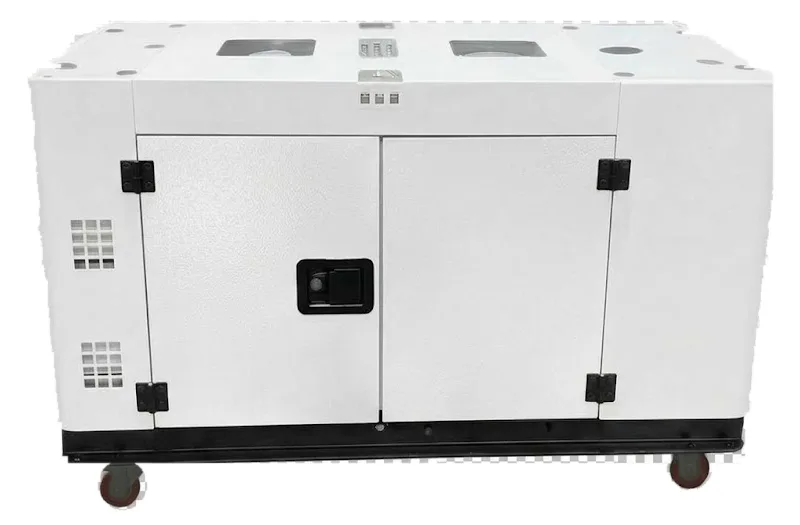
10kVA Single-Phase Water-Cooled Silent Diesel Generator Set
10 kVA
Request QuoteWhat to check before you order
- Water-cooled or air-cooled. Water-cooled single-cylinder engines turn slower and suit machines that run all day, such as mills and tractors. Air-cooled engines are lighter and suit machines that are carried or moved often. See air-cooled vs water-cooled engines.
- Replacing an engine. Send us the old engine's nameplate, photos of the mounting feet and the shaft, and the machine's input speed. We check the match before quoting.
- Fuel use. Fuel per hour is power times specific consumption. A 5 kW load on an engine rated 280 g/kWh burns about 1.7 L per hour at full load.
- Building backup. Fans and milk coolers have motors that draw a surge at start. Size the generator for that surge, and see emergency and backup power for automatic start.
Questions farm buyers ask
Should I choose an air-cooled or a water-cooled diesel engine for farm machinery?
Choose water-cooled for machines that run many hours a day, such as mills, tractors and stationary pumps. It turns slower and runs cooler. Choose air-cooled when weight matters, for example on a tiller or a portable pump, and when there is no coolant to look after.
Can you supply an engine to replace the one on my existing machine?
Often, yes. Send the old engine's nameplate, photos of the mounting and the shaft, and the input speed the machine needs. We compare the mounting, shaft and speed with our engines before we quote.
What size generator does a poultry house need?
Add up the fans, lights, feeders and heaters that run together. Then allow about three times the running power of the largest fan motor for its start. Many small and medium houses fall between 10 and 30 kVA. Our generator size calculator does the sum.
How much diesel does a farm engine use?
Multiply the power by the engine's specific consumption. Our engines are rated between 240 and 303 g/kWh. A 10 kW load at 250 g/kWh uses 2.5 kg per hour, about 3 litres.
Related guides
Need help choosing?
Our engineering team will match the right unit to your duty cycle and conditions.